
Demonizing the Villain
Against Historical Moralizing 2

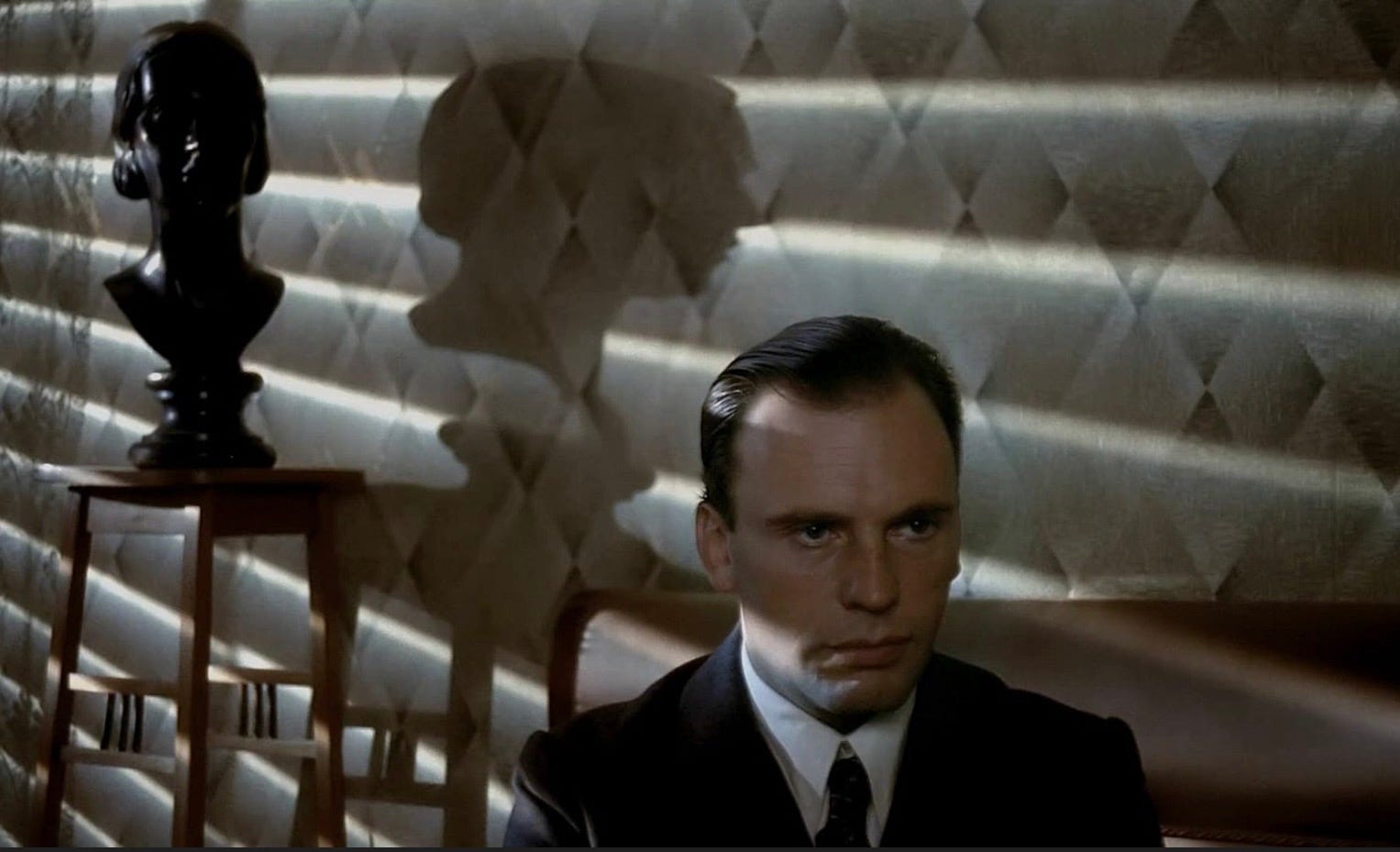
Jean-Louis Trintignant in The Conformist
If there is a Golden Rule for understanding our fellow human beings, it is that you have to take them one by one. The misapplication of general categories is the essence of prejudice. Even judging one by one, of course, is, to say the least, tricky business. We typically encounter other people in only one or two of the roles they play, and you never know how well performance in one role carries over to another. The same person can turn out to be a good friend but a poor mother, a good doctor but a bad sport. On top of that, even transient situations can have remarkable effects on people’s behavior, leading some psychologists and philosophers to argue that the very notion of character is overrated, there being no consistent moral center in people that endures regardless of situation. I do not share this degree of skepticism about the moral center, but I do believe that life offers us few examples of pure saints or villains.1
In “The Enormous Condescension of Posterity” (Feb 15), I was skeptical about the usefulness of moral categories applied to people in history. It’s not just that moralizing about the past involves applying what W. H. Auden called a “foreign code of conscience,” one that people in distant cultures or times wouldn’t recognize as governing their own understanding or behavior. It’s also that individuals are sufficiently guided both in their thought and their conduct by those around them that thinking in terms of good people versus bad people just isn’t very illuminating. To do so is to ignore the systemic and group-dependent nature of moral thinking, the situational character of action, as well as the mixed characters of most individuals.2
My fellow professors of the humanities generally disclaim a moralizing approach to scholarship. Under oath I think most of them would say that only systemic explanations can be truly illuminating in the same way that only systemic approaches to social problems can be truly effective. In practice, however, scholarship since the 1960s has taken on a heavily moralizing tone. It sees history, especially American history, as an affair of villains and victims. Recently, this hypermoralism has provoked a backlash. The current US administration and its allies have sought to suppress the discouraging facts of American history and recast them in the old heroic vein. This, of course, is just the same type of mistake with the roles reversed. (See my discussion in “Escaping the Myths of America,” July 1, 2025).
Good people/bad people is fun, of course, because we can make cause with the good people and because knowing who to hate and who to love is emotionally gratifying. Indeed, it is one of the pleasures imaginative literature exists to provide. And there is another, even more comforting side which is apparent in the way the Germans were portrayed in the decades after World War II. Both in popular and in artistically challenging novels and films, Germans were sadists, perverts, or psychopaths—people fundamentally not like us and not representative of the human race as a whole. (Once in a while a good German was thrown in to cast the others in relief.) Italian artists, ambiguously positioned given their country’s own investment in Fascism, led the way in the portrayal of the Nazis. Sexual deviance was a frequent accompaniment of Nazi sadism in movies like Luchino Visconti’s The Damned (La caduta degli dei—1969) and Liliana Cavani’s The Night Porter (1974). The Italian Fascists were perhaps even more exemplary in their depravity as shown in Pier Paolo Pasolini’s Salò: 120 Days of Sodom (1975). Even Bernardo Bertolucci’s brilliant film The Conformist (1970), which stresses its Fascist hero’s passivity and lack of genuine motivation, shows his need to conform as abnormal, rooted in childhood trauma.3 There is always a special explanation for evil.
Popular culture followed suit4 and of course no one can deny that the Nazi leadership offers sterling evidence for the sick-and-evil-Nazi thesis; the long nightmare of the war also showed that, once grand, atrocious schemes get off the drawing board, they attract and promote the sort who thrive on violence and hatred. But the starker fact is that Hitler’s designs were carried out by huge numbers of perfectly ordinary people many of whom started out with no special animus against the victims of the regime and whose behavior cannot be attributed to sexual factors or personal trauma. The sheer scale of the atrocities makes the thesis of deviance absurd. It is especially disturbing that, as Christopher Browning has noted, even though the Nazi officers in the execution unit he studied didn’t force soldiers to carry out acts of murder if they didn’t want to, only a few of them refused. It wasn’t their sick or evil characters that motivated the killers; they were just unwilling to step out of line.5
What makes this far more troubling than the sick-and-evil-Nazi thesis is that it means the Nazis in the mass weren’t so different from the rest of us after all. It is tempting to label them inhuman, but that is to disclaim the true implications of their all-too-human behavior. Demonizing and “othering” the oppressors in history, either as individuals or in groups, sustains the impression that “it couldn’t happen here.” It is not as ugly as othering the victim, but it is equally misguided, and it distracts us from the warnings that history can offer us about our own time.
The debate was ignited by Walter Mischel’s book Personality and Assessment (John Wiley & Sons, 1968). The case against character is developed at length by John M. Doris in Lack of Character: Personality and Moral Behavior (Cambridge UP, 2002).
The malleability of character in extreme situations was dramatically exemplified during this period in famous psychological experiments like the Milgram study of obedience at Yale (1962) and the Stanford Prison Experiment (1971). See Stanley Milgram et al., Obedience to Authority: An Experimental View (Harper & Row, 1974) and Philip Zimbardo, The Lucifer Effect: Understanding How Good People Turn Evil (Random House, 2007). The methods and significance of these studies have long been subject to debate. See, for example, Stewart Justman, The Psychological Mystique (Northwestern UP, 1998).
Hannah Arendt’s anti-dramatic portrayal of the “banality of evil” in Eichmann in Jerusalem (1963) still made Eichmann himself into a somewhat special psychological case.
The lurid possibilities of Nazi depravity lent themselves so richly to the big screen that “Nazisploitation” became a fetishizing genre, supremely embodied by products for the American market like as Ilsa: She Wolf of the SS (1975).
Christopher R. Browning, Ordinary Men: Reserve Police Battalion 101 and the Final Solution in Poland (Penguin, 1992), 171. Browning’s emphasis on the importance of local context rather than ideological commitment was criticized by Daniel Goldhagen in Hitler’s Willing Executioners: Ordinary Germans and the Holocaust (Knopf, 1996). Browning’s view has had stronger support than Goldhagen’s, partly for the sad reason that antisemitism and willingness to kill Jews were displayed by so many other Europeans outside Germany.